Sat Reading the Following Is an Excerpt From the Fortune Teller

Fortune telling is the do of predicting information about a person's life.[1] The scope of fortune telling is in principle identical with the practice of divination. The difference is that divination is the term used for predictions considered part of a religious ritual, invoking deities or spirits, while the term fortune telling implies a less serious or formal setting, even i of popular civilisation, where belief in occult workings behind the prediction is less prominent than the concept of suggestion, spiritual or practical advisory or affirmation.
Historically, Pliny the Elder describes use of the crystal brawl in the 1st century CE by soothsayers ("crystallum orbis", later written in Medieval Latin by scribes as orbuculum).[ii]
Contemporary Western images of fortune telling grow out of folkloristic reception of Renaissance magic, specifically associated with Romani people.[1] During the 19th and 20th century, methods of divination from not-Western cultures, such equally the I Ching, were besides adopted as methods of fortune telling in western popular civilization.
An instance of divination or fortune telling as purely an item of popular culture, with little or no vestiges of conventionalities in the occult, would be the Magic 8-Ball sold as a toy by Mattel, or Paul Two, an octopus at the Sea Life Aquarium at Oberhausen used to predict the outcome of matches played by the Frg national football team.[3]
There is opposition to fortune telling in Christianity, Islam, Baháʼísm and Judaism based on scriptural prohibitions against divination.
Terms for one who claims to run across into the future include fortune teller, crystal-gazer, spaewife, seer, soothsayer, sibyl, clairvoyant, and prophet; related terms which might include this amidst other abilities are oracle, augur, and visionary.
Fortune telling is dismissed past the scientific community and scientific skeptics as being based on magical thinking and superstition.
Methods [edit]


The screene of fortune here behold, fortune-telling game, ca.1650-1750
Mutual methods used for fortune telling in Europe and the Americas include astromancy, horary astrology, pendulum reading, spirit board reading, tasseography (reading tea leaves in a loving cup), cartomancy (fortune telling with cards), tarot card reading, crystallomancy (reading of a crystal sphere), and chiromancy (palmistry, reading of the palms). The terminal three have traditional associations in the popular mind with the Roma and Sinti people.
Another form of fortune telling, sometimes chosen "reading" or "spiritual consultation", does not rely on specific devices or methods, merely rather the practitioner gives the client advice and predictions which are said to have come up from spirits or in visions.
- Alectromancy: by observation of a rooster pecking at grain.
- Aleuromancy: by flour.
- Astrology: by the movements of celestial bodies.
- Astromancy: by the stars.
- Augury: by the flight of birds.
- Bazi or four pillars: by 60 minutes, twenty-four hours, month, and year of birth.
- Bibliomancy: by books; frequently, but not always, religious texts.
- Cartomancy: by playing cards, tarot cards, or oracle cards.
- Ceromancy: by patterns in melting or dripping wax.
- Chiromancy: by the shape of the hands and lines in the palms.
- Chronomancy: past determination of lucky and unlucky days.
- Clairvoyance: by spiritual vision or inner sight.
- Cleromancy: past casting of lots, or casting bones or stones.
- Cold reading: past using visual and aural clues.
- Crystallomancy: by crystal ball also called scrying.
- Extispicy: past the entrails of animals.
- Face reading: by means of variations in face and head shape.
- Feng shui: by earthen harmony.
- Gastromancy: by tum-based ventriloquism (historically).
- Geomancy: by markings in the ground, sand, earth, or soil.
- Haruspicy: by the livers of sacrificed animals.
- Horary star divination: the astrology of the time the question was asked.
- Hydromancy: by h2o.
- I Ching divination: by yarrow stalks or coins and the I Ching.
- Kau cim by means of numbered bamboo sticks shaken from a tube.
- Lithomancy: past stones or gems.
- Molybdomancy: by molten metal after dumped in cold water
- Naeviology: by moles, scars, or other actual marks
- Necromancy: by the dead, or past spirits or souls of the expressionless.
- Nephomancy: by shapes of clouds.
- Numerology: by numbers.
- Oneiromancy: past dreams.
- Onomancy: by names.
- Palmistry: by lines and mounds on the hand.
- Parrot star divination: by parakeets picking up fortune cards
- Paper fortune teller: origami used in fortune-telling games.
- Pendulum reading: by the movements of a suspended object.
- Pyromancy: past gazing into burn down.
- Rhabdomancy: divination by rods.
- Runecasting or Runic divination: past runes.
- Scrying: by looking at or into cogitating objects.
- Spirit board: by planchette or talking lath.
- Taromancy: by a form of cartomancy using tarot cards.
- Tasseography or tasseomancy: by tea leaves or coffee grounds.
Folklore [edit]
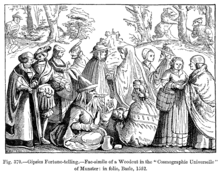
Western fortune tellers typically attempt predictions on matters such as future romantic, financial, and childbearing prospects. Many fortune tellers will also give "grapheme readings". These may use numerology, graphology, palmistry (if the field of study is present), and astrology.
In contemporary Western culture, it appears that women consult fortune tellers more than men.[4] Some women have maintained long relationships with their personal readers. Telephone consultations with psychics grew in popularity through the 1990s, and by the 2010s additional contact methods such as e-mail and videoconferencing also became available, but none of these accept completely replaced traditional in-person methods of consultation.[5]
As a business organisation in North America [edit]

Discussing the role of fortune telling in order, Ronald H. Isaacs, an American rabbi and author, opined, "Since time immemorial humans take longed to learn that which the future holds for them. Thus, in ancient civilization, and fifty-fifty today with fortune telling as a truthful profession, humankind continues to exist curious near its future, both out of sheer marvel too every bit out of desire to better ready for it."[6] Pop media outlets like The New York Times have explained to their American readers that although 5000 years ago, soothsayers were prized directorate to the Assyrians, they lost respect and reverence during the ascent of Reason in the 17th and 18th centuries.[7]
With the rising of capitalism, "the sale of occult practices [adapted to survive] in the larger club," co-ordinate to sociologists Danny L. and Lin Jorgensen.[eight] Ken Feingold, writer of "Interactive Fine art as Divination as a Vending Machine," stated that with the invention of money, fortune telling became "a private service, a commodity inside the marketplace".[9]
Equally J. Peder Zane wrote in The New York Times in 1994, referring to the Psychic Friends Network, "Whether information technology's 3 P.Chiliad. or 3 A.Yard., there's Dionne Warwick and her psychic friends selling advice on beloved, money and success. In a nation where the power of crystals and the likelihood that angels hover nearby prompt more contemplation than ridicule, it may not be surprising that 1 1000000 people a twelvemonth call Ms. Warwick's friends."[vii]
Clientele [edit]
In 1994, the psychic counsellor Rosanna Rogers of Cleveland, Ohio, explained to J. Peder Zane that a wide variety of people consulted her: "Couch potatoes aren't the only people seeking the counsel of psychics and astrologers. Clairvoyants have a booming business advising Philadelphia bankers, Hollywood lawyers and CEO's of Fortune 500 companies... If people knew how many people, especially the very rich and powerful ones, went to psychics, their jaws would drib through the flooring."[7] Rogers "claims to accept four,000 names in her rolodex."[7]
Janet Lee, also known every bit the Greenwich psychic, claims that her clientele often included Wall Street brokers who were looking for any advantage they could get. Her usual fee was around $150 for a session but some clients would pay between $2,000 and $9,000 per calendar month to have her available 24 hours a 24-hour interval to consult.[10]
Typical clients [edit]
In 1982, Danny Jorgensen, a professor of Religious Studies at the University of South Florida offered a spiritual explanation for the popularity of fortune telling. He said that people visit psychics or fortune tellers to gain self-understanding,[xi] and cognition which will atomic number 82 to personal ability or success in some aspect of life.[12]
In 1995, Ken Feingold offered a different caption for why people seek out fortune tellers:[nine]
We want to know other people's actions and to resolve our own conflicts regarding decisions to exist fabricated and our participation in social groups and economies. ... Divination seems to take emerged from our knowing the inevitability of decease. The idea is articulate—we know that our time is express and that we want things in our lives to happen in accord with our wishes. Realizing that our wishes have niggling power, we accept sought technologies for gaining knowledge of the hereafter... gain power over our own [lives].
Ultimately, the reasons a person consults a diviner or fortune teller depend on cultural and personal expectations.
Services [edit]
Traditional fortune tellers vary in methodology, generally using techniques long established in their cultures and thus meeting the cultural expectations of their clientele.
In the U.s.a. and Canada, amongst clients of European beginnings, palmistry is popular[thirteen] and, as with astrology and tarot card reading, advice is by and large given well-nigh specific problems besetting the client.
Non-religious spiritual guidance may also exist offered. An American clairvoyant by the name of Catherine Adams has written, "My philosophy is to teach and practice spiritual freedom, which ways you accept your own spiritual guidance, which I tin can help you lot arrive touch with."[14]
In the African American community, where many people practice a grade of folk magic called hoodoo or rootworking, a fortune-telling session or "reading" for a client may be followed by practical guidance in spell-casting and Christian prayer, through a process chosen "magical coaching".[fifteen]
In add-on to sharing and explaining their visions, fortune tellers can also act like counselors by discussing and offering advice about their clients' problems.[13] They want their clients to do their ain willpower.[xvi]
Total-time careers [edit]

Some fortune tellers support themselves entirely on their divination business; others hold downwards one or more than jobs, and their second jobs may or may not relate to the occupation of divining. In 1982, Danny L., and Lin Jorgensen found that "while in that location is considerable variation among [these secondary] occupations, [part-fourth dimension fortune tellers] are over-represented in homo service fields: counseling, social work, teaching, health care."[17] The aforementioned authors, making a express survey of North American diviners, found that the bulk of fortune tellers are married with children, and a few claim graduate degrees.[18] "They attend movies, watch television, work at regular jobs, shop at 1000-Mart, sometimes eat at McDonald's, and go to the hospital when they are seriously ill."[19]
Legality [edit]
In 1982, the sociologists Danny Fifty., and Lin Jorgensen found that, "when it is reasonable, [fortune tellers] comply with local laws and purchase a concern license."[17] Nonetheless, in the United States, a diverseness of local and state laws restrict fortune telling, require the licensing or bonding of fortune tellers, or make necessary the apply of terminology that avoids the term "fortune teller" in favor of terms such as "spiritual advisor" or "psychic consultant." There are as well laws that outright forbid the practice in certain districts.
For instance, fortune telling is a class B misdemeanor in the country of New York. Under New York State police force, South 165.35:
A person is guilty of fortune telling when, for a fee or compensation which he directly or indirectly solicits or receives, he claims or pretends to tell fortunes, or holds himself out as existence able, by claimed or pretended utilise of occult powers, to respond questions or give advice on personal matters or to exercise, influence or bear on evil spirits or curses; except that this section does non apply to a person who engages in the aforedescribed conduct every bit role of a prove or exhibition solely for the purpose of entertainment or amusement.[20]
Lawmakers who wrote this statute acknowledged that fortune tellers do not restrict themselves to "a show or exhibition solely for the purpose of entertainment or amusement" and that people will keep to seek out fortune tellers even though fortune tellers operate in violation of the law.
Similarly, in New Zealand, Department sixteen of the Summary Offences Act 1981 provides a ane m dollar penalization for anyone who sets out to "deceive or pretend" for fiscal recompense that they possess telepathy or clairvoyance or acts equally a medium for coin through utilise of "fraudulent devices." As with the New York legislation cited above, however, it is non a criminal offence if it is solely intended for purposes of amusement.
Saudi arabia too bans the practice outright, considering fortune telling to be sorcery and thus opposite to Islamic didactics and jurisprudence. Information technology has been punishable by death.[21]
Critical assay [edit]
Fortune telling is dismissed by the scientific community and skeptics as being based on magical thinking and superstition.[22] [23] [24] [25]
Skeptic Bergen Evans suggested that fortune telling is the consequence of a "naïve pick of something that take happened from a mass of things that haven't, the clever interpretation of ambiguities, or a brazen announcement of the inevitable."[26] Other skeptics claim that fortune telling is nil more than cold reading.[27]
A large amount of fraud has occurred in the practice of fortune telling.[28]
Fortune telling and how it works raises many disquisitional questions. For example, fortune-telling occurs through various methods such every bit psychic readings and tarot cards. Similarly, these methods are largely based on random phenomena. For example, astrologers believe that the move of stars in the sky can have implications on one's life.[29] In the case of tarot cards, people believe that images displayed on the cards have significant meanings on their lives. Nonetheless, there is a lack of show to support why such things, such every bit the stars, would have whatever implications on our lives.
Additionally, fortune-telling readings and predictions fabricated by horoscopes, for example, are oftentimes general enough to employ to anyone. In common cold reading, for example, readers oft begin past stating general descriptions and continuing to make specifics based on the reactions they receive from the person whose life they are predicting.[30] The tendency for people to deem general descriptions as being representative to themselves has been termed the Barnum event and has been studied past psychologists for many years.[31]
Nonetheless, even with a lack of evidence supporting the diverse methods of fortune-telling and the many frauds that accept occurred by psychic readers, amongst others, fortune-telling continues to go popular around the earth. There are many reasons for the highly-seasoned nature of fortune-telling such equally that people oft experience stress when in that location is uncertainty and thus seek to gain deeper insight into their lives.
Meet likewise [edit]
- Chinese fortune telling
- Divination in African traditional religion
- Flim-Flam! (Psychics, ESP, Unicorns and other Delusions)
- Fortune teller machine
- Houdini's debunking of psychics and mediums
- I Ching divination
- Bob Nygaard (Psychic investigator)
- Televangelist Peter Popoff exposed by James Randi
- Prophecy
- Psychic Blues: Confessions of a Conflicted Medium
- Rose Mackenberg (Historic investigator of psychic mediums)
- Tengenjutsu (fortune telling)
Notes [edit]
- ^ a b Melton, J. Gordon. (2008). The Encyclopedia of Religious Phenomena. Visible Ink Printing. pp. 115-116. ISBN i-57859-209-7
- ^ Pliny the Elder (1831). Caii Plinii Secundi Historiæ naturalis libri xxxvii, cum selectis comm. J. Harduini ac recentiorum interpretum novisque adnotationibus. p. 579. Retrieved 7 November 2015. (in Latin)
- ^ Associated Press6 July 2010
- ^ Blécourt, Willem de; Usborne, Cornelle. (1999). Women'southward Medicine, Women's Culture: Abortion and Fortune telling in Early on Twentieth-Century Germany and the Netherlands. Medical History 43: 376-392.
- ^ Burton, Valentina. The Fortune Teller's Guide to Success: Creating a Wonderful Career every bit a Psychic. 2011; Lucky Mojo Curio Co. (revised) Fourth Edition 2018.
- ^ Isaacs, Ronald H. Divination, Magic, and Healing the Book of Jewish Folklore. Northvale North.J.: Jason Aronson, 1998. pg 55
- ^ a b c d (Zane 1994)
- ^ (Jorgensen & Jorgensen 1982, p. 376)
- ^ a b (Feingold 1995, p. 399)
- ^ Kadet, Anne (8 March 2014). "In Greenwich, Where Money Is No Object". The Wall Street Periodical. Archived from the original on 12 November 2017. Retrieved 31 Jan 2019.
- ^ (Jorgensen & Jorgensen 1982, p. 381)
- ^ (Jorgensen & Jorgensen 1982, p. 375)
- ^ a b "Clear-sighted or counsellor? Run across the woman who walks a fine line." The Northern Echo. 27 Oct 2000.
- ^ Adams, Catherine. "What is Clairvoyance and What Tin can I Expect in a Session With Catherine?" Archived 18 December 2007 at the Wayback Motorcar
- ^ "Magical Coaching and Spiritual Advice are among the ancillary services offered by some diviners and root doctors. These consultation services are usually engaged on an hourly footing." -- excerpt from an article on "magical coaching" at the Association of Independent Readers and Rootworkers web site
- ^ (Jorgensen & Jorgensen 1982, p. 384)
- ^ a b (Jorgensen & Jorgensen 1982, p. 377)
- ^ (Jorgensen & Jorgensen 1982, p. 337)
- ^ (Jorgensen & Jorgensen 1982, p. 387)
- ^ Leginfo.country.ny.us
- ^ Fortune Teller Faces Execution in Saudi arabia Archived four April 2010 at the Wayback Machine pattayadailynews.com 1 April 2010 retrieved 17 July 2010
- ^ Pronko, Nicholas Henry. (1969). Panorama of Psychology. Brooks/Cole Publishing Visitor. p. eighteen
- ^ Miller, Gale. (1978). Odd Jobs: The Globe of Deviant Work. Prentice-Hall. pp. 66-68
- ^ Carroll, Robert Todd. (2003). "Divination (fortune telling)". The Skeptic'due south Dictionary. Retrieved 20 April 2016.
- ^ Majestic, Brian. (2009). Pseudoscience: A Critical Encyclopedia. Greenwood. p. 55. ISBN 978-0-313-35507-iii
- ^ Evans, Bergen. (1955). The Spoor of Spooks: And Other Nonsense. Purnell. p. xvi
- ^ Cogan, Robert. (1998). Critical Thinking: Stride by Stride. University Press of America. p. 212. ISBN 0-7618-1067-six
- ^ Steiner, Robert A. (1996). Fortunetelling. In Gordon Stein. The Encyclopedia of the Paranormal. Prometheus Books. pp. 281-290. ISBN 1-57392-021-5
- ^ Thagard, Paul R. (1978). Why astrology is a pseudoscience in The Philosophy of Science Association, 1978 Volume 1, pp. 223-234.
- ^ Dutton, D.L. (1988). The Cold Reading Technique in Experientia, Book 44, pp. 326-332
- ^ Dutton, D.50. (1988). The Common cold Reading Technique in Experientia, Volume 44, pp. 326-332
References [edit]
- Feingold, Ken (1995), "OU: Interactivity as Divination equally Vending Machine", Leonardo, Third Annual New York Digital Salon, 28 (5): 399–402, doi:x.2307/1576224, JSTOR 1576224, S2CID 61727726
- Hughes, Thou., Behanna, R; Signorella, M. (2001). Perceived Accuracy of Fortune Telling and Belief in the Paranormal. Periodical of Social Psychology 141: 159-160.
- Jorgensen, Danny L.; Jorgensen, Lin (1982), "Social Meanings of the Occult", The Sociological Quarterly, 23 (3): 373–389, doi:10.1111/j.1533-8525.1982.tb01019.ten .
- Zane, J. Peder (11 September 1994), "Soothsayers as Business Advisers; You Are Going to Go along a Long Trip…", The New York Times .
External links [edit]
-
 Media related to Fortune-telling at Wikimedia Eatables
meansplefuspritir.blogspot.com
Source: https://en.wikipedia.org/wiki/Fortune-telling
0 Response to "Sat Reading the Following Is an Excerpt From the Fortune Teller"
Post a Comment