The Enlightenment Brought Important Changes in Art the Impact of the Enlightenment Worksheet

7a. The Touch of Enlightenment in Europe
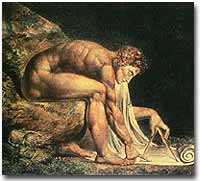
Blake
Blake's representation of Newton.
The Historic period of Reason, equally information technology was called, was spreading rapidly across Europe. In the tardily 17th century, scientists like Isaac Newton and writers like John Locke were challenging the erstwhile gild. Newton's laws of gravity and move described the globe in terms of natural laws beyond any spiritual strength. In the wake of political turmoil in England, Locke asserted the right of a people to change a government that did not protect natural rights of life, freedom and property. People were beginning to uncertainty the beingness of a God who could predestine homo beings to eternal damnation and empower a tyrant for a king. Europe would be forever changed by these ideas.

In America, intellectuals were reading these ideas as well. On their side of the Atlantic, Enlightened ideas of liberty and progress had a adventure to flourish without the shackles of One-time Europe. Religious leaders began to modify their old dogmatic positions. They began to emphasize the similarities between the Anglican Church and the Puritan Congregationalists rather than the differences. Even Cotton Mather, the Massachusetts minister who wrote and spoke and so convincingly nigh the being of witches advocated science to immunize citizens confronting smallpox. Harvard ministers became so liberal that Yale College was founded in New Haven in 1707 in an endeavour to retain old Calvinist ideas. This attempt failed and the entire faculty except 1 converted to the Church of England in 1722. By the terminate of the century, many New England ministers would become Unitarians, doubting even the divinity of Christ.
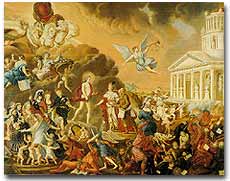
painting by Duplessis
Triomphe de Voltaire
New ideas shaped political attitudes likewise. John Locke defended the displacement of a monarch who would not protect the lives, liberties, and property of the English people. Jean-Jacques Rousseau stated that society should be ruled by the "general will" of the people. Businesswoman de Montesquieu declared that power should non be concentrated in the hands of any one individual. He recommended separating power among executive, legislative, judicial branches of government. American intellectuals began to absorb these ideas. The delegates who declared independence from United kingdom of great britain and northern ireland used many of these arguments. The entire opening of the Declaration of Independence is Thomas Jefferson's application of John Locke'due south ideas. The constitutions of our first states and the United States Constitution reflect Enlightenment principles. The writings of Benjamin Franklin made many Enlightenment ideas accessible to the general public.
The sometime way of life was represented past superstition, an angry God, and absolute submission to authority. The thinkers of the Age of Reason ushered in a new mode of thinking. This new fashion championed the accomplishments of humankind. Individuals did not accept to have despair. Science and reason could bring happiness and progress. Kings did non rule past divine right. They had an obligation to their subjects. Europeans pondered the implications for nearly a century. Americans put them into do commencement.

If you like our content, please share it on social media!


0 Response to "The Enlightenment Brought Important Changes in Art the Impact of the Enlightenment Worksheet"
Post a Comment