When Was There a Lot of Art in Greece
The nude effigy is a universal visual theme, deeply rooted in the history of art, and it is seemingly ubiquitous in the art of the ancient civilizations of the Most E and Mediterranean. The Antikenmuseum, in Basel, Switzerland, recently opened a new exhibition - Naked! The Fine art of Nudity - which advisedly examines every facet of nude art in the aboriginal world, probing its pregnant and legacy in Western conceptions of beauty and morality. In this exclusive interview for Ancient History Encyclopedia, James Blake Wiener speaks to Dr. Tomas Lochman, curator of the exhibition at the Antikenmuseum, about how ancient peoples in the Mediterranean and Near E viewed nudity.
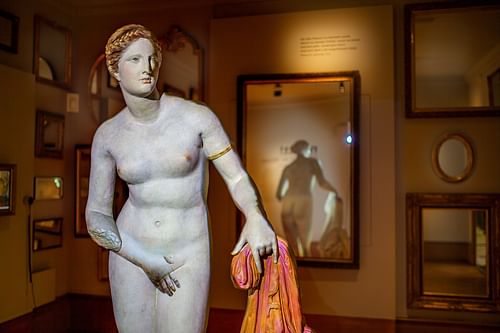
Aphrodite of Knidos with Colours
JBW: With the ongoing debates surrounding feminism, gender studies, and, more than recently the #MeToo move, many people are raising questions about the artistic representation of naked bodies in our museums. Was Naked! The Art of Nudity organized equally a reaction to these controversies and socio-cultural currents? If and then, which questions or issues does the exhibition attempt to address and why?
Questions around censuring of nudes in art motivated us to pursue a very simple question: "Why are there so many nudes in ancient art"?
TL: In the beginning, we planned this exhibition with the aim to put a focus on a cardinal phenomenon in the art of ancient cultures: Nudity is omnipresent, having multiple connotations and significance. Also, this large topic gave us an opportunity to regroup thematically and diachronically our permanent collections. The option of possible exhibition items is nigh unlimited and thus very favorable for a special exhibition without encountering high costs normally acquired when assembling specific loans from international museums.
Besides this artistic angle, at that place is as well a supplementary reasoning for the "naked" evidence, and this is the recent give-and-take about sexism in art, which gives our exhibition a touch of brisance and relevance. All these questions around censuring of nudes in fine art motivated us to pursue a very simple question: "Why are in that location so many nudes in ancient fine art"?
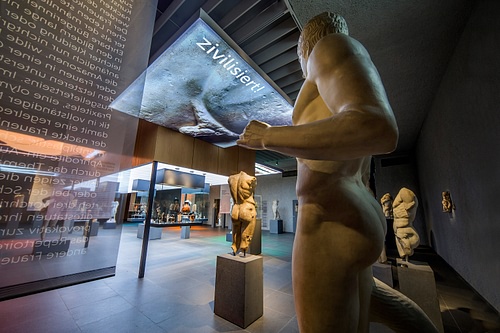
Naked! The Fine art of Nudity Exhibition, Antikenmuseum, Basel
JBW: In the ancient Near Eastward, thousands of stone and terra cotta figurines accept been excavated and depictions of female person nudity predominate. Would you say there is a common denominator amongst these nude female figurines, Dr. Lochman? If then, what is the connection besides the nakedness?
TL: Information technology is axiomatic that all these prehistoric figurines from the Almost Eastward (and not only those from the About East, just also from elsewhere) bear witness the female trunk not merely naked but besides in a form that clearly accentuates its sexuality. The breasts, the pelvis, and also the genitals are clearly emphasized, whereas caput, arms, and feet are reduced. The common denominator is in my stance that the figures' aim is to celebrate female sexuality or fertility.
JBW: In what ways did the ancient Egyptians link nudity to social condition as well as eroticism in art? It should be mentioned that the ancient Egyptians routinely depicted the gods and children as naked too.
TL: In ancient Egyptian iconography, the social rank of a person was defined by dress; therefore, nudity signified, first and foremost, a "lack of status." And yes, information technology is true that the aboriginal Egyptians also depicted children as naked, as they had no status yet also. In contrast to that particular aspect of nudity in ancient Egyptian art, nudity, of grade, played an important office in eroticism and in the appraisal of the beauty and attractiveness of immature women. We find naked girls on the handles of toiletries as well in the and so-called concubines, which were burial objects added to the grave as substitutes for companions to the grave of deceased men.
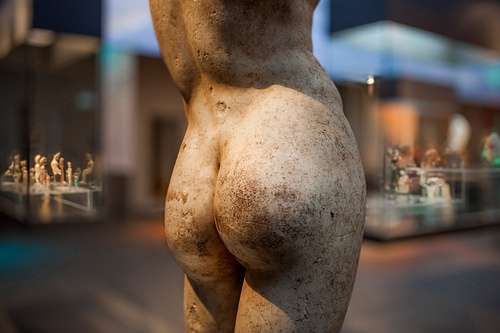
Ancient Posterior from the 'Naked! The Art of Nudity' Antikenmuseum Exhibition
JBW: While touring the exhibition, I was fascinated by the process in which nudity was later on normalized inside Greek art. Might yous comment on this farther, Dr. Lochman? Perhaps more than any other Western civilization or culture, we associate the ancient Greeks with the naked trunk.
TL: Nudity is predominant in ancient Greek art, more than in other cultures, indeed. Only more important than the nudity is the fact that the human body in general is the quasi-exclusive topic of Greek arts. Nonetheless, most of the human figures in ancient Greek art do not represent mortal humans, only rather gods and heroes. Some – and this is typical for the Greek anthropocentrism – fifty-fifty stand for allegorical figures that personify topographic places, as well as abstract objects and terms.
The aboriginal Greek representation of ideal men rendered nudity as a kind of "uniform."
Therefore, the human trunk is an important medium for subordinated values or meanings, which provides enough reasoning for depicted bodies to announced better than in nature and fifty-fifty "perfect." A mortal man could simply arroyo the heroic condition of gods through preparation their body in sports. (Of class, they also had to do and subject area their heed and spirit too!) Representations of idealized athletes engaged in sport while fully nude are common in Greek art. The aboriginal Greek representation of platonic men rendered nudity every bit a kind of "uniform." This is why nudity is such a predominant grade of figural representations within ancient Greek art.
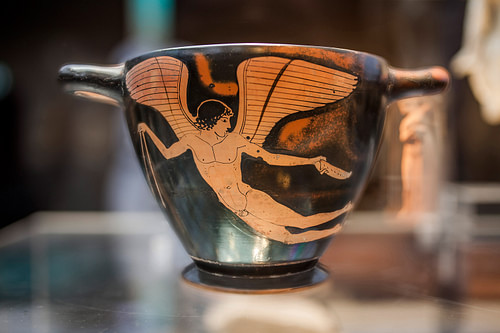
Cherry-red-Figure Cup with Eros Figure
JBW: Dr. Lochman, the Etruscans seemed to differ sharply from that of the Romans who, while frowning upon public nudity, were nonetheless eager to have their private homes filled with nude statues of heroes, deities, and even erotic images. How did the Etruscans view nudity and express it in their own artistic traditions?
TL: Ane of the significant differences betwixt the Etruscans and the Greeks and Romans is the fact that Etruscan women enjoyed more freedom in social life than Greek and Roman women. Whereas the Greeks sports were reserved to men but, Etruscan girls could practice sport together with the boys and in complete nudity! Public outdoor nudity for both sexes was, therefore, nix unusual, and it did non have any potential for scandals. This explains why the Etruscans also had a lower reservation confronting erotic images in the arts.
JBW: The exhibition contains objects made by the ancient Mesopotamians, Egyptians, Syrians, Greeks, Etruscans, and Romans. Among the objects on display, which among them are considered "highlights"? Additionally, practice you take whatever personal favorites among the items from the exhibition?
TL: Even if the exhibition is dominated by Greek works of art, and despite the fact that I am a specialist in Greek and Roman sculpture, two of my favorite highlights are not from Greece or Rome, but from Syrian arab republic and Arab republic of egypt. The kickoff one is a Syrian idol – the nearly ancient item in the exhibit, which dates from around 5000 BCE. It depicts an enthroned opulent dazzler in accentuated sexuality, thus jubilant female fertility. The 2nd one is the Egyptian bosom of a lady from the court from around 1300 BCE during the New Kingdom (c. 1550 BCE–c. 1077 BCE). She is dressed, only her clothes act as light drapery; the elegant curves and shape of her body appear underneath as if she were naked.
This kind of interplay between revealing and concealing was non only a Greek speciality from the end of fifth century BCE, but it was already mastered by Egyptian artists nine centuries earlier! One highlight from the Greek department should be mentioned here too: The marble torso of the Polykleitian Diadumenos type. Even if this is a later Roman copy, the piece of work is of such fragile fineness that it tin can be considered as the best of all Roman replicas after the lost masterwork of Polykleitos (fl. 5th century BCE).
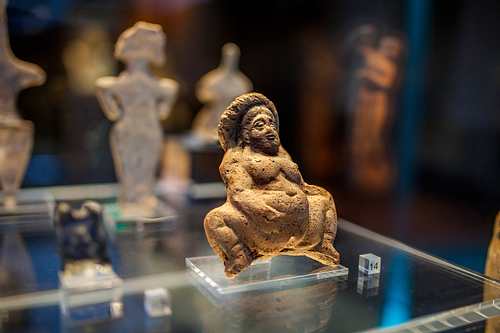
Roman Voluptuous Naked Figurine
JBW: For artists in ancient times, the depiction of nudity had diverse associations across space and time; for instance, information technology was tied to immortality, religious sanctity, the pristine state of nature, in addition to notions of culture. Have nosotros deviated all that much from our ancient ancestors when it comes to nudity in the artistic nude? What are your thoughts, Dr. Lochman?
TL: Nudity is omnipresent not simply in ancient arts, but also in modern art where information technology is generally accepted. The only problem that we may accept with nudity in art occurs when represented nudity is non understood or is considered every bit gratuitous. In the aboriginal times, nudity always had justification. We can distinguish between ritual nudity, heroic nudity, civilized nudity, uncivilized nudity, legitimized nudity, and erotic nudity.
Strangely, explicit erotic representations, such as those figuring on specific symposium vases, are for many spectators less provocative and then naked woman in modern creative nudes, where the reasons for the nakedness are not concretely discernible (or is not understood anymore).
JBW: Dr. Lochman, on behalf of Aboriginal History Encyclopedia, I thank you so much for sharing your knowledge with us and for introducing our readers to this compelling exhibition. I wish yous many happy adventures in your research until nosotros next meet again.
TL: Many thanks to y'all and AHE for the interest in our exhibition!
Naked! The Art of Nudity runs at the Antikenmuseum in Basel, Switzerland until April 28, 2019.
Dr. Tomas Lochman was born 1959 in Prague, Czech republic, and he has lived in Basel, Switzerland since 1969. He studied Classical Archeology at Basel University from 1980-1986, and he earned his doctorate degree in 1993 with a dissertation on Roman Phyrgia. Since 1986, Dr. Lochman has worked at the Antikenmuseum in Basel, becoming the curator in charge of Greek and Roman Sculpture at the Antikenmuseum in 2013. From 2000-2016, Dr. Lochman was the president of the "International Clan for Conservation and Promotion of Casts" (I.A.C.P.C.). In 2006, he received a research grant of the French CNRS as guest at the Institut Français des Etudes Anatoliennes in Istanbul, Turkey. Lochman'due south enquiry areas include ancient sculpture (from Greece, Rome, and the Eastern Roman Empire) as well as the reception of Antiquity in mod times. In his museum exhibitions and events, Lochman traces deliberately the afterlife of historical heritage in contemporary popular media. Lochman'southward most important exhibitions are "Antico-mix" (Artifact in Comics), "Antike im Kino" (Antiquity in Cinema), "The fine art of Swiss neo-Classical Sculptor Ferdinand Schlöth," "Roma Eterna" (a presentation of sculptures from the Santarelli and Zeri collections), and "Naked! The Fine art of Nudity."
This commodity has been reviewed for accuracy, reliability and adherence to bookish standards prior to publication.
meansplefuspritir.blogspot.com
Source: https://www.worldhistory.org/article/1295/interview-nudity-in-the-ancient-world/
0 Response to "When Was There a Lot of Art in Greece"
Post a Comment